SGBV E-Training Portal

Welcome to the SGBV E-Training Portal of the Nigeria Police Force.

This course is developed by the Nigeria Police in collaboration with the Ford Foundation, Justice Research Institute, The National Agency for the Prohibition of Trafficking in Persons (NAPTIP), UN Women, and the NPF’s ICT department.

Some of you are already posted to the Gender and Family Support Unit and managing GBV cases; others may be working in related areas of gender violence but may want to enhance your knowledge and understanding of how to respond to and prevent gender-based violence in your areas of responsibilities.

Other officers may be working on SGBV programs in collaboration with other agencies and non-governmental organizations and may be taking this course to be better prepared.

Effectively responding to and preventing SGBV requires developing a foundational understanding of SGBV to inform responding to and preventing its occurrence.

SGBV cases can affect society, causing violence, especially against women, girls, and other vulnerable groups – people with disabilities and religious and sexual minorities.

This course will help you get a comprehensive overview of SGBV and is presented in the following modules:

  • Module one – Understanding Sexual and Gender-Based Violence

  • Module two – Police handling of Sexual and Gender-Based Violence

  • Module three – Preventing Sexual and Gender-Based Violence

  • Module four – Responding to Sexual and Gender-Based Violence

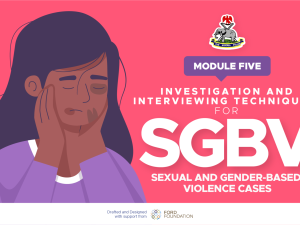
  • Module five – Investigation and Interviewing techniques for SGBV
Courses / Modules

Acronyms and Abbreviations

During your online study, you will come across some words being abbreviated while some serves as acronyms. Below are some of the acronyms and abbreviations.

CSO – Civil Society Organization

COVID-19 – Corona Virus Disease 2019

GBV – Gender-Based Violence

NPF – Nigeria Police Force

SGBV – Sexual and Gender-Based Violence

UN Women – United Nations Entity for Gender Equality and the Empowerment of Women

VAPP – Violence Against Persons (Prohibition) [Act]

Definition of Terms

Accused – Someone against whom a civil or criminal case is brought.

Alternate dispute resolution – A mechanism and structure put in place by some state governments to intervene in some cases to decongest the justice system. Cases of sexual violence are, however, criminal offences that must be prosecuted.

Arrest – To take a suspect or a perpetrator by legal authority into custody.

Conviction – Finding a suspect guilty of an offence by establishing the crime committed against the person through a court judgement.

Court order – An official proclamation by a competent court of law directing certain steps to be taken in a case.

Defendant – Someone against whom a criminal or civil case is brought.

Detention – An act of holding someone in custody for legal reasons.

Evidence – Any object, material or item that may be submitted to prove a case or establish a fact in a court in order to establish the truth about a matter under investigation in the court.

Exhibit – Evidence provided to support a criminal charge against a suspect. It could be an object or photograph.

Interrogation – A process of questioning to get details about certain cases or to establish facts. It is usually done in a systematic way.

Interview – To make deliberate efforts to gain relevant information from parties involved in a case.

Party – A person or entity or institution involved in a law suit. It implies both the defendant and the respondent, which also in this case refers to the survivor and the suspect.

Prosecution – A process of establishing a criminal charge against someone in a court of law by an authorized institution such as the police.

Remand – Keeping an accused person or suspect in the custody of a legal or competent authority such as the Nigerian Correctional Service.

Suspect – A known person accused of a certain crime.

Warrant – A written statement permitting or authorizing a law enforcement officer to undertake an act including arrest and search.

Witness – Someone who appears in a court of law to give additional information about what s/he knows in a criminal or civil proceeding.